
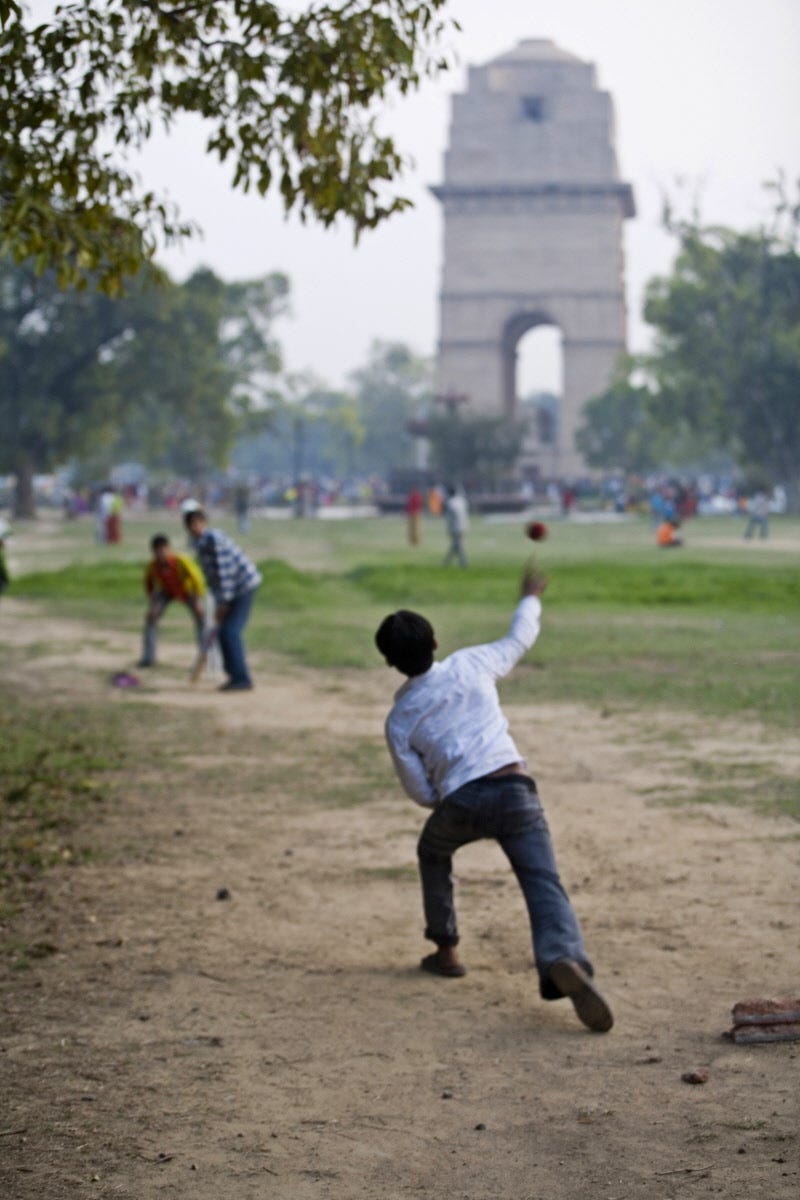
Cricket at India Gate lawns - Stuart Freedman, Panos Pictures, 2007
In 1988, five lakh farmers occupied the Boat Club lawns for a week in October, the biggest of a string of historic rallies on these grounds since the early days of Independent India. In 1971, India Gandhi had used the venue as a show of her strength; later that year, Atal Bihari Vajpayee led a Jan Sangh rally against the budget. Here, students protested against the Emergency in 1975, and, in 1990, Devi Lal mobilised a show of strength after Prime Minister VP Singh dismissed him as his deputy.
By 1993, democratic protest was pushed off the center stage of New Delhi’s Central Vista, and exiled to the armpit that is Jantar Mantar. The Kartavya Path Police Station now guards the northern flank of the lawns. Democratic power has been replaced by State Power.
Kartavya Path, once Rajpath, runs from west to east, 3.2 kilometers from the forecourt of Rashtrapati Bhavan, to India Gate, where the sprawling C-Hexagon is India’s largest roundabout. In these 42 acres of land, three generations of Dill-wallas picnicked, romanced, and - unbelievable as it may sound - even learned to drive. Cricket clubs* had nets more or less permanently in place, and of a winter weekend, scores of matches - friendly and fiercely competitive - would take place on its dusty lawns.
The lawns are now a lush green, well-watered and well-mannered, surrounded by a wrought iron fence that runs some two kilometers along its periphery, guarding the National War Memorial. Sand stone structures honour the brave dead, but the living are reduced to mute audience. No picnics, no cricket. And no entry before nine in the morning. Or after six thirty in the evening. Valorous souls must be allowed to sleep on time.
A couple of miles to the west, in Chanakyapuri, a six acre park was converted to the Police Memorial in 2018, following almost two decades of legal contestation about the nature of permissible land use. Mondays closed.
Central Delhi is strewn with yellow metal barricades, deployed by the thousands to screen off the powerful from the hoi-polloi. VIP convoys have become longer and more elaborate, and the pain quotient for ordinary citizens has steadily mounted. Yesterday, I rode my cycle in Lutyen’s Delhi, waving out to boisterous bunches of runners, many leading with national flags fluttering in the humid breeze. Returning from Talkatora Stadium, I was turned back from an Akbar Road roundabout because a VIP convoy had nearly run into one such group. The lead driver had to brake hard. Imagine that. No injuries, the policeman reported, but runners and cyclists were no longer allowed on this stretch.
The exclusionary tendency has gathered force over the decades. Indira Gandhi was the last Indian Prime Minister to live on a road with public access. When Rajiv Gandhi moved into Bungalow number seven on Race Course Road - now called Lok Kalyan Marg - it was sealed at both ends. Over the decades, the security rings have grown tighter and more elaborate. If you walk along the periphery of the Delhi Gymkhana Club, on the other side of Lok Kalyan Marg, the Prime Ministerial road is screened off by twelve foot high walls, punctuated by sentry towers, festooned with razor wire.
The logical exclusionary move is to take over the Delhi Gymkhana Club, now well under way, as you have probably heard. The Polo grounds and the Delhi Flying Club are already done deals. Rulers need their secure sanctuaries, their isolated enclaves of privilege. Ironically, in New Delhi, as in Beijing and Moscow, centers from which power is now exercised in the name of the people occupy sites of earlier Imperial Powers.
In Beijing, the Forbidden City was set up by the Ming Dynasty in the 14th century. To its immediate west, Zhongnanhai is the principal compound of the Chinese Communist Party leadership and the central government. Senior Party leaders have offices and, historically, residences there. Inscrutable security around the compound ensures that the Chinese public has no access.
In Moscow, Soviet Russia made its headquarters in the Kremlin, from where Ivan the Great ruled in the 15th century. Secured behind high walls, and cossetted by privileged stores that sold scarce delicacies, the nomenklatura had their residential compounds in the vicinity. After the dissolution of the Soviet Empire, the circle of wealth widened, and the elite are now more geographically dispersed across Moscow.
In July, we had my birthday brunch at a chic cafe in the ‘Blloku’ neighbourhood of Tirana, the capital of Albania. ‘Blloku’, for block, was the enclave in which Enver Hoxha, one of Europe’s last dictators, isolated himself and his cronies from public view. His villa, now revealed to be surprisingly modest, stood behind high walls in the heart of the block. Now called Villa 31, it hosts cultural events and public exhibitions, and its walls are almost comically low, as an ostentatious expiation for sins long past.
Meanwhile, back home in Delhi, the Indira Gandhi National Center for the Arts, inaugurated only in 2001, has been demolished to make way for Common Central Secretariat buildings 1, 2, and 3.
*https://www.espn.in/cricket/story/_/id/22247331/delhi-maidan-story
I thought renaming Rajpath was dopey thinking. The Raj is alive and kicking in Lutyens. The roadblocks are for keeping the riffraff away from Lutyens royalty.
This brought to mind an empirical study of Section 144 in Delhi (by Vrinda Bhandari and Ors) about the gradual conversion of public space into administered and controlled space. (see here: https://papers.ssrn.com/sol3/papers.cfm?abstract_id=4389147)
The researchers examined nearly 5,400 Section 144 orders issued in Delhi in 2021. Surprisingly, only 81 (about 1.5%) were the familiar kind prohibiting public assembly. Far more were used for everyday regulation: CCTV requirements, record-keeping by businesses, restrictions on various ordinary activities, etc.
Their phrase for it is the “normalisation of an extraordinary law” meaning emergency powers becoming part of the routine infrastructure of governing the city. It is not dramatic closure of public space, but a cumulative process of restriction, surveillance and exclusion.