Namaste

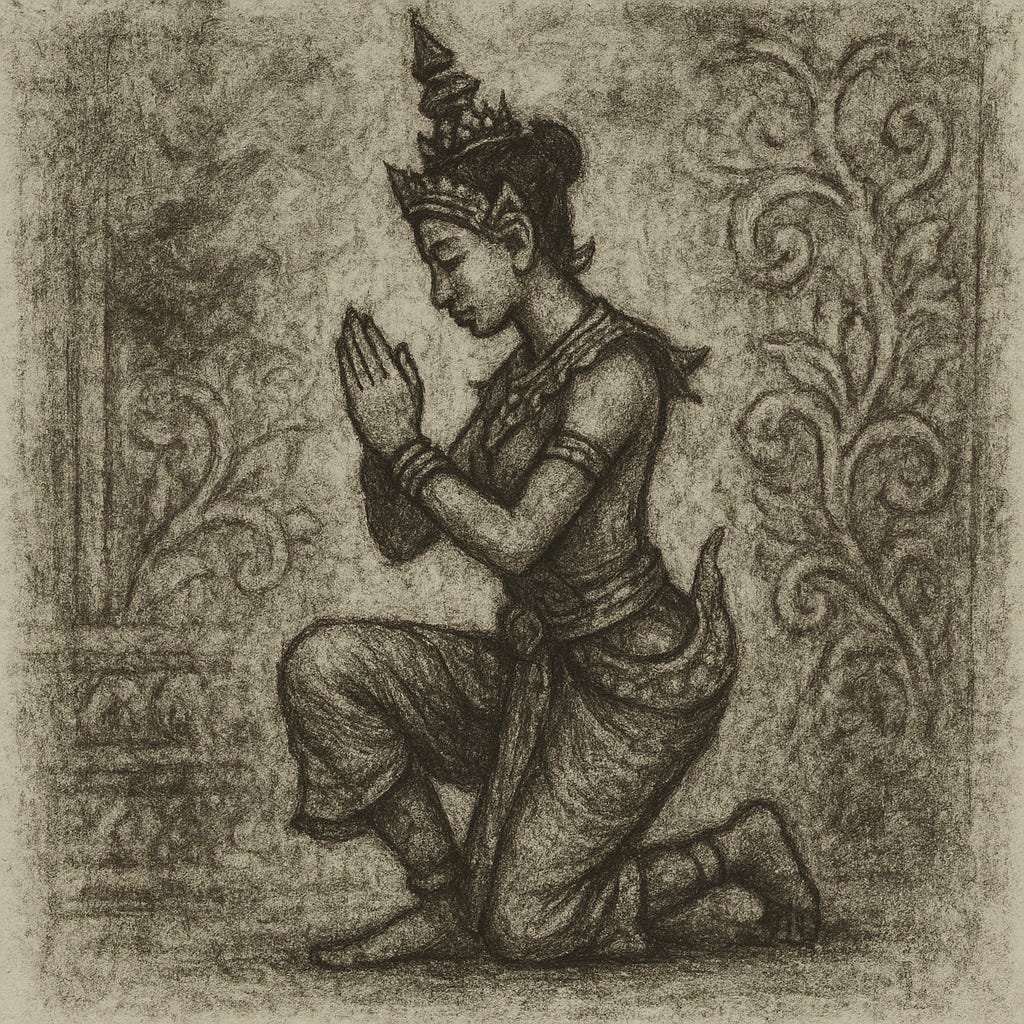
The first time I was greeted by a Namaste in Thailand, I had a brief experience of cultural dissonance. How did the hotel receptionist know I was Indian even before I reached the desk? How did she know this was the traditional Indian greeting?
Within a few hours, I realised that the boot was on the wrong foot (wrong anatomical appendage, I know) - while the Namaste may have originated in India, it was practiced much more widely in Thailand, and with sublime grace. Nothing perfunctory about the Thai Namaste. When a Thai greets you with a Namaste, it seems as if she actually pauses for a second, to acknowledge your presence, to say,
“The divine in me honors the divine in you”
This explanation of Namaste was given me by a very erudite man, Badrinath Chaturvedi*. The literal meaning of the term is simply, “I bow to you”. The more elaborate take I absorbed in my youth was probably inspired by the idea of Advaita, or non-duality. Since the individual and the ultimate reality are identical, in bowing to you, I bow to the universal.
In most of India now - or the India I encounter - we bow only to power. Domestic staff greet you with a Namaste. I rarely reciprocate. The greeting has become largely hierarchical.
The one Indian setting in which it is most graceful, and most ubiquitous, is in luxury hotels. From the watchman to the lobby staff, to the bellboy who brings your luggage to your room, the Namaste is well-rehearsed, and gracefully deployed. I find it charming, but I have to say that it seems performative.
Of course, politicians greet rallies with a Namaste. This is even more performative. Or, you could say, it falls squarely within the power matrix. The power that flows from the ballot box is the ultimate power in our democracy, a power increasingly unconstrained by other institutions. If a few Namastes in public settings bring you power for five years, during which you ride roughshod over Aam Janta, then perform it to the hilt.
Cynicism apart, the question I often ask myself is why we, and I speak especially of myself, lost the habit of Namaste. Maybe colonialism had something to do with it. But my grandfather’s generation, who lived most of their lives under the British, were a lot more gracious in their greetings than we are.
Beyond the gesture, how much respect do we have for the other? Do we take that one second to acknowledge his presence when a waiter arrives at our table to give us a menu, or take our order. Do I stop to acknowledge his extreme youth and vulnerability, to respect the fact that young Shubham has left his home in Chhattisgarh to come and wait at seasonal tables in a shack in Benaulim?
Or fold my hands to Sonu, all of eighteen, who dropped out of school in Jharkhand last year, after his father’s truck was repossessed by the bank, and went into a depression. This year, he brought his friend Suraj to Goa with him, he of the flashing smile and melting eyes. “I have many things to talk to you about”, Suraj said. I still wait to hear his story.
When I drop my swimming bag in the shack, at the beginning of my morning walk, Suraj and Sonu are still asleep on the floor, their little bodies shrouded against the morning cool. When I return an hour later, they are smiling and attentive as always. Ever helpful, ever gracious.
So much to respect, so much to fold our hands to. And even if inertia, the force of a habit lost, prevents one from saying Namaste,
“Please”, I try to remind myself every day, “Please begin every engagement with a second to acknowledge all that lies within the soul in front of you.”
*Here are some books by Badrinath Chaturvedi:
Swami Vivekananda: The Living Vedanta — Penguin India, 2006.
The Mahabharata: An Inquiry in the Human Condition — Orient BlackSwan, 2006.
Women of the Mahabharata: The Question of Truth — Orient BlackSwan, 2008.
Dharma: Hinduism and Religions in India — Penguin/Viking, 2019.
Dharma, India and the World Order: Twenty‑one Essays — 1993.
Finding Jesus in Dharma: Christianity in India — 2000.
In Bali, Indonesia, where I was both visibly a tourist and yet regularly mistaken for a native because of my facial features, I was clean bowled to be greeted by "Om Swasti Astu" and a slight but gracious bow with joined palms, at every point of contact in the tourism/hospitality bubble.
I always reciprocated with all the sincerity that I could muster, deeply touched by the living practice of the dharma that permeates the landscape and its people within a Muslim majority nation.
Ganesh greeted us at every threshold, freshly garlanded and worshipped, a constant presence in all our peregrinations.
And all this under the crushing weight of international tourism that has gone on for 50 years and shows no signs of abating.
I was humbled and inspired. India is neither superior not possesses a monopoly in the practice of Dharma.
Decades ago, half a century ago actually, early work trips as shippies tasked to head for the US to bring shiploads of wheat back to India, I recall learning how to introduce myself by name, extend a hand to shake, and wait for the other person to reciprocate. High or low didn't matter.
Replaced with Namaste over decades. And observing how the other person would or would not respond.