
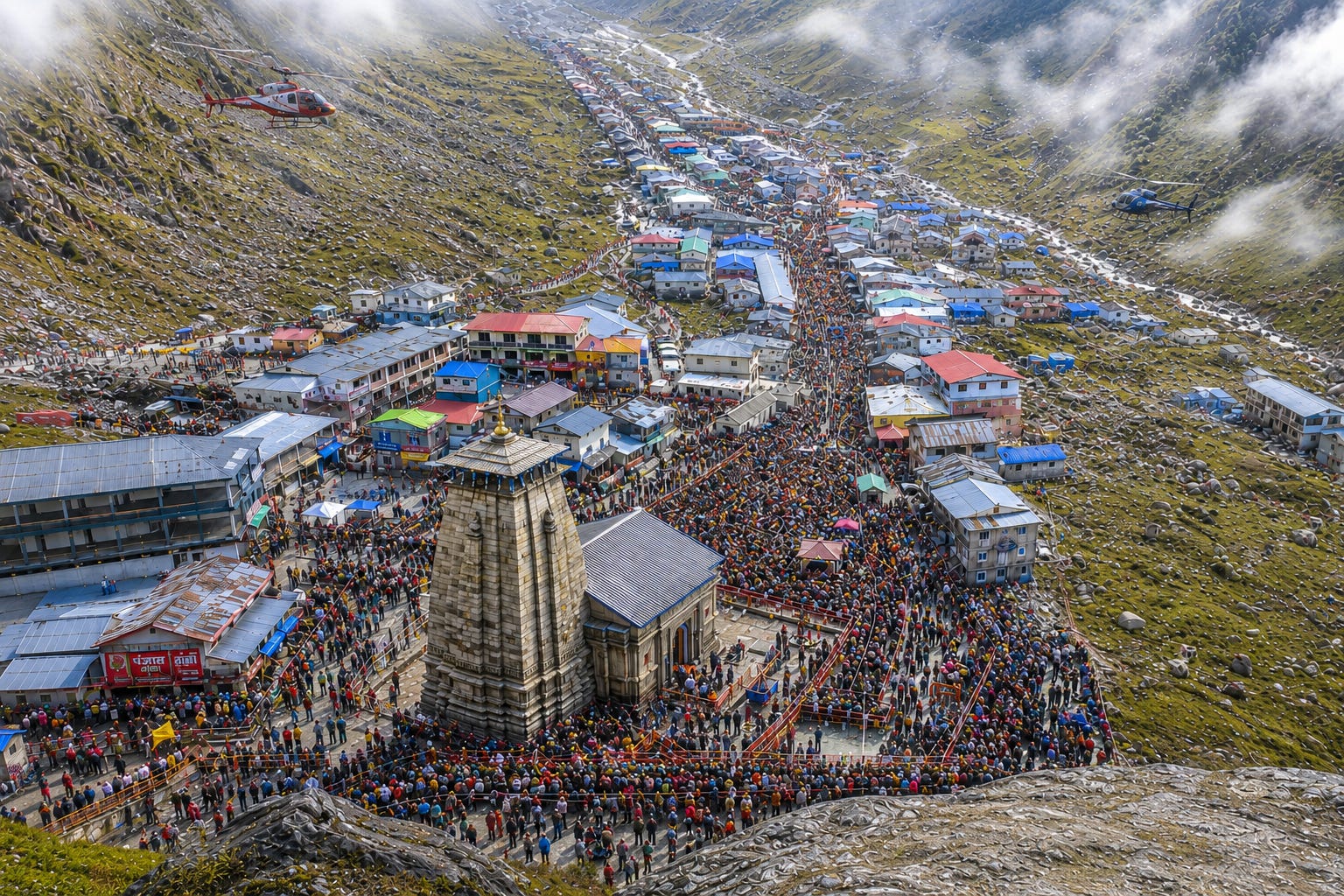
Kedarnath - image by ChatGPT
It all started with that pumped-up jock, Bhima.
It was one thing to slay a few Asuras during his exile. I mean, thirteen years in the forest - when you are used to the pomp and grandeur of a court - must get pretty boring. Besides, no one in their right minds would miss Hidimba, or Bakasura, who demanded one human being a week to feed his greed.
Things got decidedly more heated when the Pandavas finished their thirteen years in the boondocks. Their emissary, Krishna, took himself to Hastinapur, to ask for the return of their kingdom. Duryodhana refused. By Day Four of the battle that ensued, Bhima found his stride, and took out the first of his cousins, Senapati. Seven others followed that day, including his namesake, Bhima the Kaurava. Duryodhana was the last to go, on Day Eighteen, slayed by a foul blow below the waist.
But the most spectacular scene of Bhima’s revenge was on Day Seventeen, when he felled Dushasana, the dastardly Kaurava who had dragged Draupadi into the gambling hall by her hair. Bhima ripped Dushasana’s arms apart, tore his chest open, and true to his dark oath, drank Dushashana’s blood directly from his heart.
The last bugles of war were sounded. Conches were blown to mark Yudhishtira’s ascendancy to the throne of Hastinapur. Now Bhima, this warrior of muscle and gore, turned all philosophical on us, and wanted me to answer questions about the purpose of war, the futility of violence.
Now you know me: I am not much given to words, and prefer a life of quiet contemplation atop a remote peak. When Bhima began to pester me with these questions, I tried to shake him off: “These are very subtle concepts, O Bhima, not the realm of a muscleman”. But when his questions became insistent, I picked up my damru, slung my trishul over my shoulder, and high-tailed it into the Himalaya.
I hadn’t reckoned with the man’s persistence. A few days later, Bhima tracked me up the Ganga, along the Alaknanda, took a left where the Mandakini coursed down a narrow valley, up into meadows bedecked with flowers, where cattle were grazing in the summer sun. I spotted him from afar, and scarcely had time to decide which form to don, to escape his boring questions. Given the location, I decided to become Kedarnath, Lord of the fields, and took the shape of a grazing bull.
Maybe Bhima was not as dumb as I thought - he immediately saw through my disguise. The days of strenuous trekking had done nothing to take the edge off his impetuous rage. Angered by my reluctance to engage in fruitless words, he drew his sword, and slashed the hapless bull into five bits. I retreated into myself and migrated to a snowy peak high above the meadows.
When the other Pandavas caught up with Bhima, they roundly cursed him for his unmanageable rage. I think he, too, was stricken by remorse, and he joined them in building a temple around the spot where the bull’s hump had fallen. Kedarnath, they called it. On a clear day, I could see its flag fluttering from atop my perch, this monument to my essential being, to my determined silence and eternal contemplation.
Millennia passed, the snows piled up in the winter, and melted in the spring. Cattle grazed in the glorious summer, and took shelter under vast rocks in the thunderous storms of the monsoons. The granite blocks of the temple weathered in the sun, and shifted in the raging winds of August and September.
By the time a seeker from distant Kerala strode up the Mandakini, the Kedarnath temple was looking a little worse for wear. Shankaracharya, they called him. He was nothing if not a man of action, devoted to the resurgence of the Indian tradition. The work of repair he began with his own bare hands was then taken up by the incredibly wealthy ruler of Malwa, King Bhoj, and when I opened my eyes on a full moon night, the renewed granite temple was an imposing presence against the icy walls of the mountains.
He was also a voracious reader, this first, or Adi, Shankaracharya, and unearthed some texts declaring I had once appeared at this spot as a column of light. That must have been a long time ago - I have but a faint memory of this particular dance. Nevertheless, he declared the temple a jyotirlinga, the site of a divine manifestation of light.
Shankaracharya certainly had his finger on the popular pulse, and his teachings ignited some kind of Zeitgeist. By the time the Skanda Purana was written up, this Kedar temple was on the map of spiritual tourism, and whole sections were written about the glories of bathing in the Mandakini, and of performing Shraadha for one’s ancestors
Fine by me. These were quiet pilgrims, trudging difficult paths in treacherous terrain. As long as there was no Bhima among them, no restless, insistent soul trying to catch my ear, demanding easy answers to questions which deserve centuries of contemplation.
Then, the cold reclaimed the valleys of the Mandakini. The Little Ice Age descended, sending tongues of snow and ice down the valley, making passage increasingly difficult.
Aah, the silence, the glorious isolation, the endless cycle of moon and stars.
Barely two centuries ago, the glaciers melted. It was like time melted, too, became fluid and rapid, gathered speed, and then lost control. New maps were made, new arteries for transport and travel. Up the valleys the pilgrims came, in buses and cars, on motorcycles and trucks that doubled as people carriers. Up the Mandakini they trudged, or were hauled, in palanquins or on coolie-back, in their fathers’ arms, or in baskets on the stout backs of mountain coolies.
In search of the Shiva who refused to speak, the Kedar who would rather be slaughtered than be interrogated. Up the Mandakini, whose waters they had sullied, drinking water encased in plastic, filled at factories in industrial estates in the filthy plains. Forgive me if I snort a little derisive snort, before I return to my silence.
That’s becoming a little elusive though, that silence. Over the last few decades, I’ve gotten used to the clopping of mule hooves on the cobbled stones of the mountain track from Phata. Even to the honking of impatient taxi drivers at the parking lot. The bhajans from loudspeakers - that took a lot more forbearance on my part, and a few years ago, I traded in my damru for a larger one, the better to drown out the besuraa notes that began to clatter around the landscape.
Now, the world has visited a new blight upon us - seekers of instant enlightenment, who buzz up and down the Mandakini in metallic dragonflies, perfidious whining carapaces that are way more insistent than even Bhima, whom I regarded like an unwanted earworm.
Maybe I should have entertained him, given him some existential riddles to chew upon, to take back to Hastinapur, leaving these meadows in glorious silence, with no trace of our quiet encounter. Too late now - that genie left the lamp a long, long time ago, and this valley seems destined for the ongoing assault of millions of swelling bodies every summer.
I’m thinking I need to go further afield to find some silence. I’ve been hearing about this crazy guy called Elon Musk - yeah, I’m plugged into the internet, too. Maybe I should get myself a seat on the first flight to Mars.
Kedarnath? No one will miss me here.
This was an amazing read! Very well written and relatable! On a trip to Rishikesh a few years ago, I was sitting on the terrace of the hotel I was staying at. I could see the Ganges maybe half a kilometre away. Suddenly there was loud music - apparently some folks were partying on the other side. No different to the loud, out of tune shenanigans that pass for pujas and aartis at the pandals during sundry festivals. So sad. Hai yeh kalyug used to a dramatic dialogue said in jest a couple of decades ago. Seems it and our species end has started with gusto now :(
I have never been to Kedarnath, neither do I wish to go. Whatever happens there in the peak bhakti (aka tourism) season is far away from devotion.
The title is so apt here- Shiva's Lament.