Shiva's Wedding Procession

Shiva’s Wedding
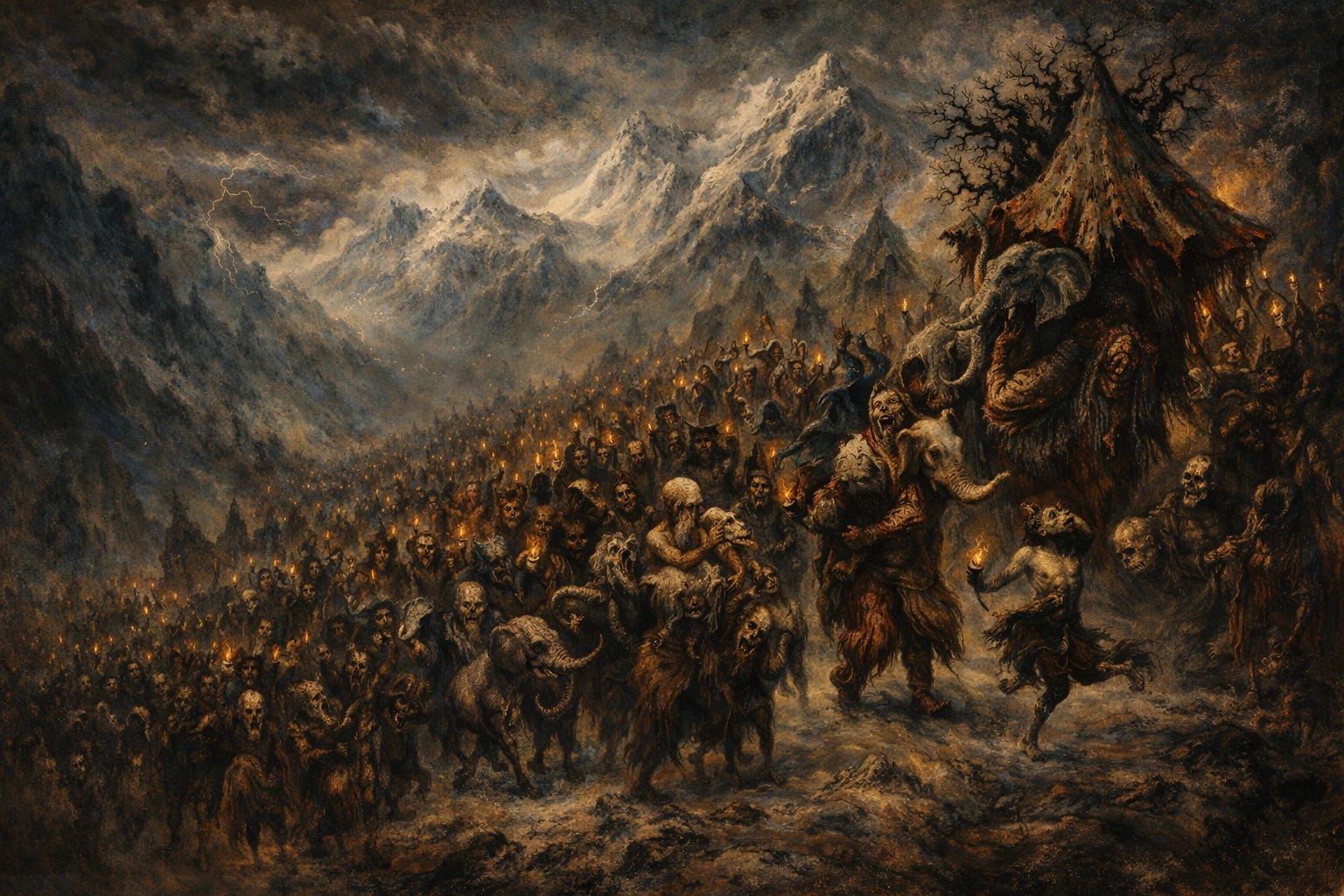
A Procession of Strange Beings - Glibatree Art Design
One monsoon, just as we were setting off for the Valley of Flowers, we received news that the bridge across the Bhyundar had been washed away. Instead, we decided to explore the rolling meadows of Panwalikantha, in the Kedarnath region. Late one monsoon evening, we found lodgings at an ashram in Triyuginarayan.
Here, the pandit at the temple told us, Shiva married Parvati, the daughter of Himavat, the king of the mountains. Shiva arrived unescorted, unwashed and unclothed as was his wont, his skin covered only in ashes. Parvati’s mother fainted in horror.
What will the neighbours think? No ceremonial baraat, as befits the groom of a princess, no drums and elephants, no ceremonial music?
As a gesture of conciliation, apparently, Shiva manifested a baraat. But it was no ordinary procession of family and royal hangers-on dressed in all their finery. Instead, it was a chimera of cosmic proportions, populated by ghosts and goblins, snakes and spirits. An eighteenth century poet, Nazir Akbarabadi, described the wedding in a long work, Mahadev-ji ka Byah, and I found a translation* of some of the passages in Dr. Karan Singh’s anthology - Shiva, Lord of the Cosmic Dance.
I loved the imagery and the cadence of the lines, and decided that I would learn to recite them. I found that they were easier read than said, and I wondered whether rendering them in Iambic Pentameter would help me find a rhythm that rolled more easily off the tongue. I turned to ChatGPT for a first draft, which led to a second and a third…
Here is the text I am now working with, told from the view point of an unwitting spectator:
 What masque is this the night hath tutor’d forth?
 The ground doth quake, though no true thunder breaks.
 Mine eyes grow false, or else the world grows mad;
 For see—by thousands press they from the dark,
 Not men, but shapes dream’d up by fever’d sleep.

 Ghosts crowd with goblins; demons throng like flies.
 Great giants stoop, as if the heavens bow’d them,
 Their heads heap’d high with mountains made of cloth;
 And from those folds — O monstrous sight - there spring
 Black banyan trees that clutch the choking air.

 Some walk bare-crown’d, their hair in matted spears,
 Like bamboo rank’d against all rule of art.
 Some are but heads that laugh without a heart;
 Some bodies leap whose heads are elsewhere lent;
 Some dance outright with neither leg nor foot,
 Yet keep a measure I have long forgot.

 One bears an elephant upon his neck
 As nurses do a child; another hugs
 A camel close beneath his arm; one drags
 A buffalo as lovers drag their sin;
 One wears a rhinoceros for a crown.
 About their throats live serpents twist and breathe,
 Whose hissing hoods they kiss with rapture wild.
 Some brandish iron bars; some knotty clubs.

 They howl like winds broke loose from ocean caves;
 They trumpet joy like beasts that know no death.
 Their arms beat time; their eyes outstrip their thoughts.
 In monstrous bounds they clear the measured earth.

 Oh shapes ill-born! O revel not of men!
 This is no feast, but some great power loose
 Who bends nature into hideous forms.
 If this be mirth, then mirth hath teeth and claws—
 And I, poor fool, stand quaking on its brink.
Exeunt Spectator, stumbling in the dark. Thunder…
*translation by Changez Batliwala, rendered into Shakespearean cadence by ChatGPT and self.
Fascinating approach here. Framing this through the spectator's POV adds psychological weight that the original myth might not carry. I've seen similar translations from myth to meter flatten the weirdness, but keeping that visceral confusion (the quaking ground, the fever dream quality) makes the cosmic stuff feel genuinly threatening rather than just grand.